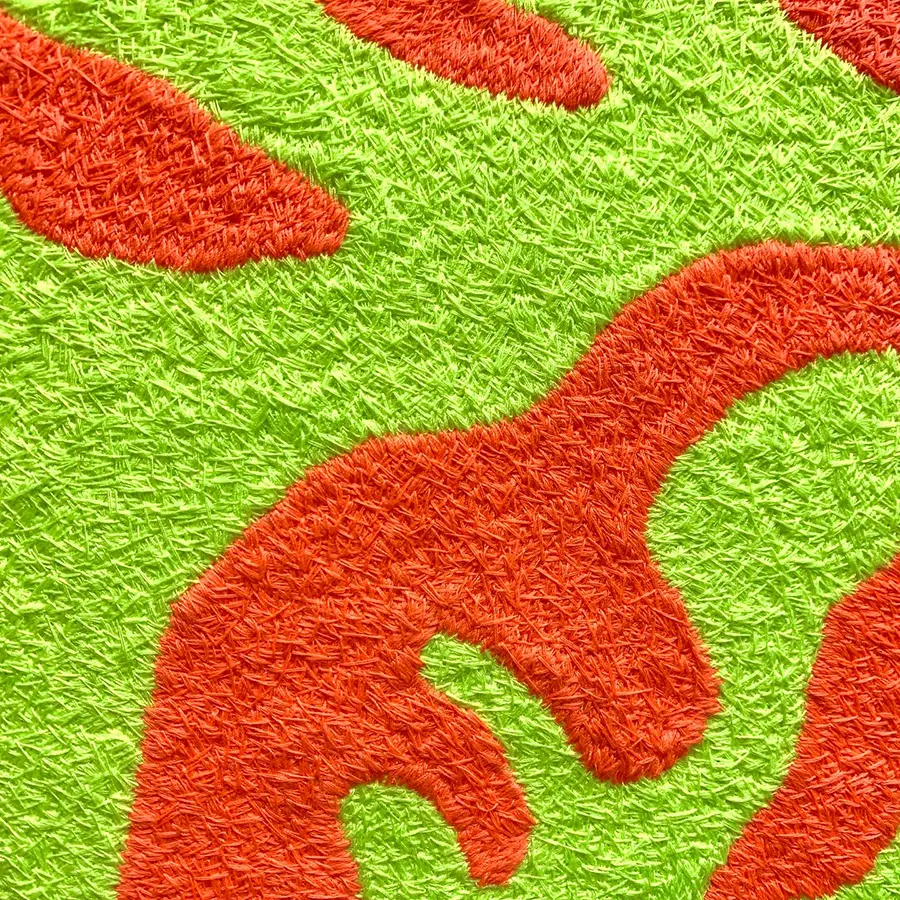
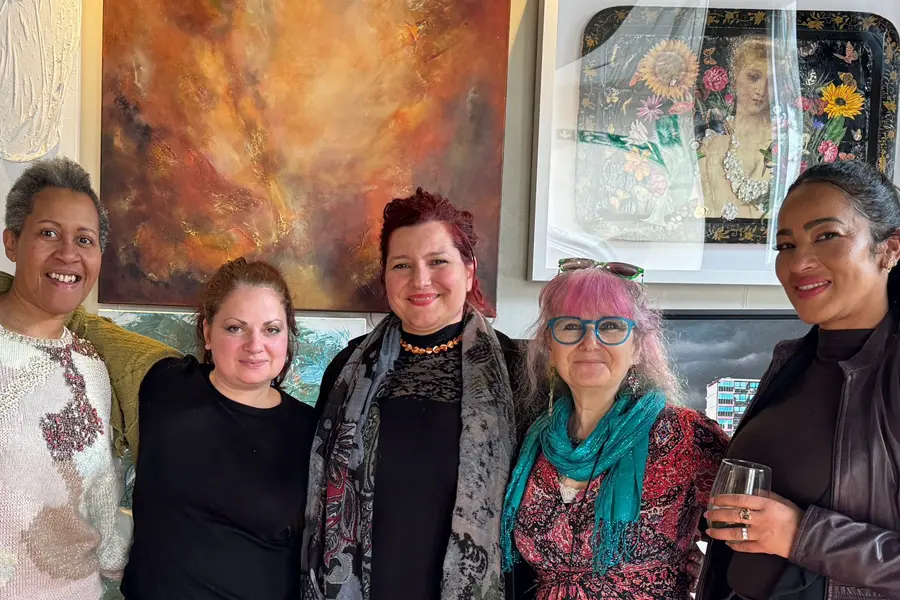
JPR Stitch (aka. Dr. Jack Roberts) is a fine artist who uses stitch to create calm balanced and tranquil abstract artworks. We have been following Jack’s journey for a few years and we thought that it was about time we had another chat to catch up with him about his art and practice.
We first spoke to Jack back in 2023 where he told us about how he arrived at his distinct flowing abstract style and how his academic background and artworld career had informed his practice (you can read this article here). Since then, there has been an interesting development in his practice – he is creating larger artworks by combining smaller stitchings.
We will leave the ‘intros’ (as you can read that in our first conversation with Jack) and just jump straight in..
Last time we spoke, I think the largest work you shared with us was about A3 in size – now some of your works are much bigger, what changed?
Well, the biggest stitching I do is still A3 but yes, some of my artworks are much bigger than that… let me explain.
I always wanted to create large artworks, but I create my stitchings on a domestic sewing machine. I like working on a domestic machine because I can fix it when it is broken and also take it with me – in the summer I take it outside into my garden to work.
One of the issues with these machines is that creating a stitching much larger than A3 becomes really hard, there is too much canvas to manoeuvre under the sewing machine. This left me with the dilemma of how do I create an artwork that is larger than A3 without creating a stitching that is larger than A3… it seemed impossible.
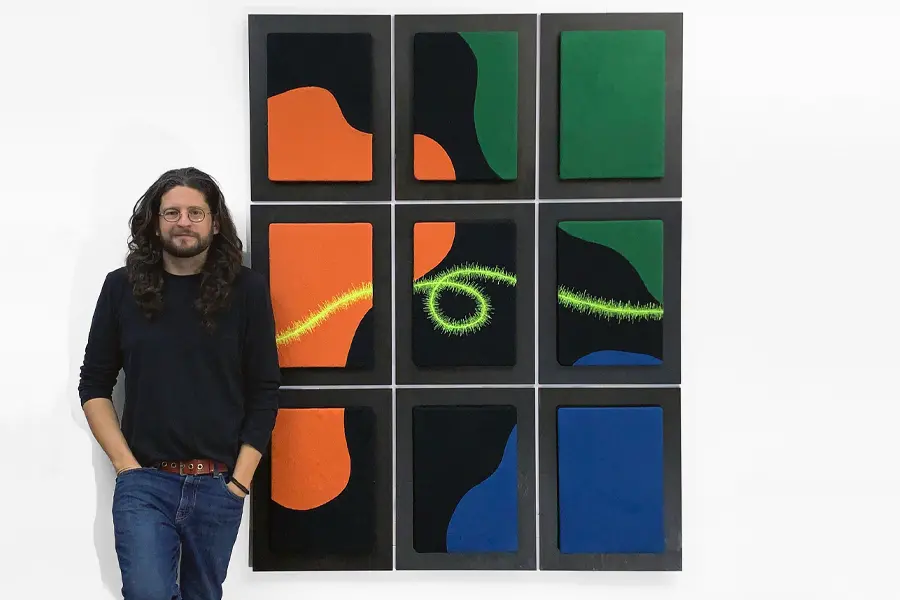
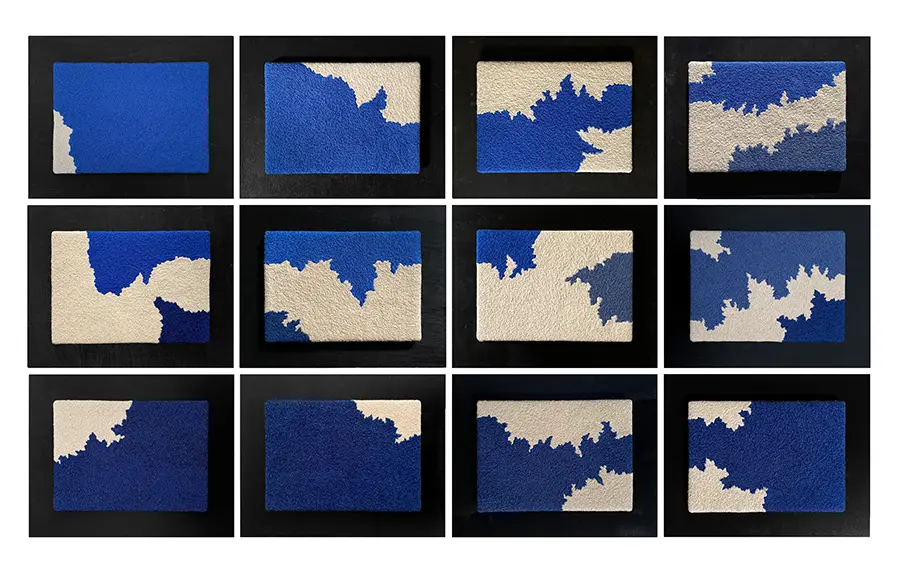
After a while, I had an epiphany, if I could combine groups of individual artworks together with a design that flowed from one stitching into the next maybe I could solve the problem, I could create larger artworks by combining groups of stitchings. I tried it out and it worked!
August 22 in Shrewsbury Museum
August 22
August 22 – detail
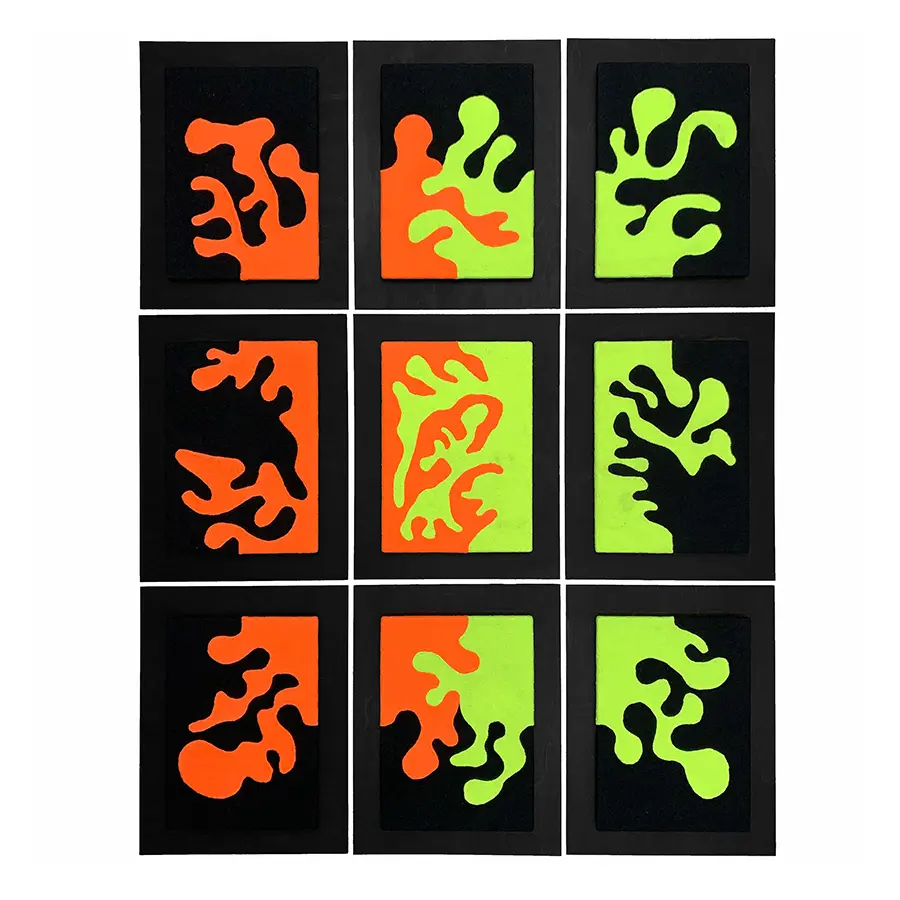
Each individual stitching is stretched onto a backboard to keep it tight, this is then mounted onto a larger black stained board (as with my individual stitchings) but then, for these group artworks they are displayed in a specific way so that the design from the individual artworks flows from one piece into the next.
I like to keep a gap between the artworks so that you can see the wall behind as this seems to emphasise that the artwork is created from a group of smaller pieces – but the spaces don’t distract, your mind fills in the gaps and the groups of stitchings becomes greater than their individual parts.
One huge advantage of creating larger artworks out of smaller stitchings is that the groups can be flexible to fit spaces. They can be displayed in their entirety; they can be split into smaller sets to be spread around a room (for example to go either side of a fireplace or along a corridor); or even spread out so the gaps between the artworks are much more imposing. They are artworks that can change and be flexible to the space.
March 24 – detail
March 24
I have heard of a ‘tryptic’ (where three panels are combined to create one artwork), but what do you call an artwork created from nine, 12, or even 15 panels?
In the artworld, there is the word ‘polyptych’, which is the name for two-dimensional artworks which are created from combining more than three panels, but that sounds a bit too ‘academic’ and complicated for me. As you know from our last chat, I try hard to simplify things.
When I first started to title my one-off individual stitchings, I really didn’t know what to call them, so whilst I was thinking and exploring options, as a way to keep a track of them, I dated each stitching on the back with the date it was completed (12/02/25 for example).
And after reflecting, this seemed to fit perfectly for the title, my art is about capturing a sense of calmness, and using the date as the title seemed to anchor the artworks to the time they were created, so that is what I used – each individual artwork is titled with the date it was completed.
In the same way, after I had created my first larger work, I didn’t know what to call it. I thought about how smaller parts are combined to create larger things in other art forms – in literature, chapters come together to create a book; in theatre scenes come together to create acts, acts come together to create plays; in poetry, lines come together to create verses, verses come together to create poems… I was writing all of this down and I wrote a question to myself – ‘what do you call a collection of artworks?’
When I reflected, I realised, I had been overthinking it and I had already answered my own question (within the question itself) – a collection.
I call my single stand-alone stitchings ‘individual artworks’ and when individual stitchings come together into a group, I call them ‘collection artworks’. All individual stitchings are titled with the date they were completed (dd/mm/yy) and all collection artworks are titled with the month the collection was completed (for example December 2024).
December 22
December 22 – detail
So, you still create smaller one-off pieces as well as the larger collections?
Yes, this is for two reasons, inspiration and length of time. A collection artwork that has 9 large stitchings would take me around 3-4 months to create, there is a huge amount of stitching over and over to create these pieces. An A5 individual stitching (the smallest pieces I create) would take me around 5 or so days to create, so there is a vast difference.
After I have spent four or so months creating a collection artwork, I can feel quite exhausted and feel like I need a creative ‘refresh’, which is why I usually then spend a couple of months working on one-off individual stitchings. Also, it takes a while for the inspiration and ideas for the next collection artwork to build, so I need to give myself the time between creating collection pieces to allow the creative juices to flow.
I am beginning to notice a pattern within my practice – I spend about three or four months creating a collection artwork. When I finish, I want to work on something smaller for a while, so I then spend a couple of months creating individual artworks. After about two months of creating individual artworks, one of these stitchings will inspire me to create a collection artwork, and so the six-monthly cycle begins again. On average, I create two collection artworks a year.
You talk about individual artworks inspiring collection artworks – how does your design process work?
There is a big difference between the design process for the individual artworks and for the collection artworks – the collection artworks need much more planning to ensure the design flows from one stitching into the next.
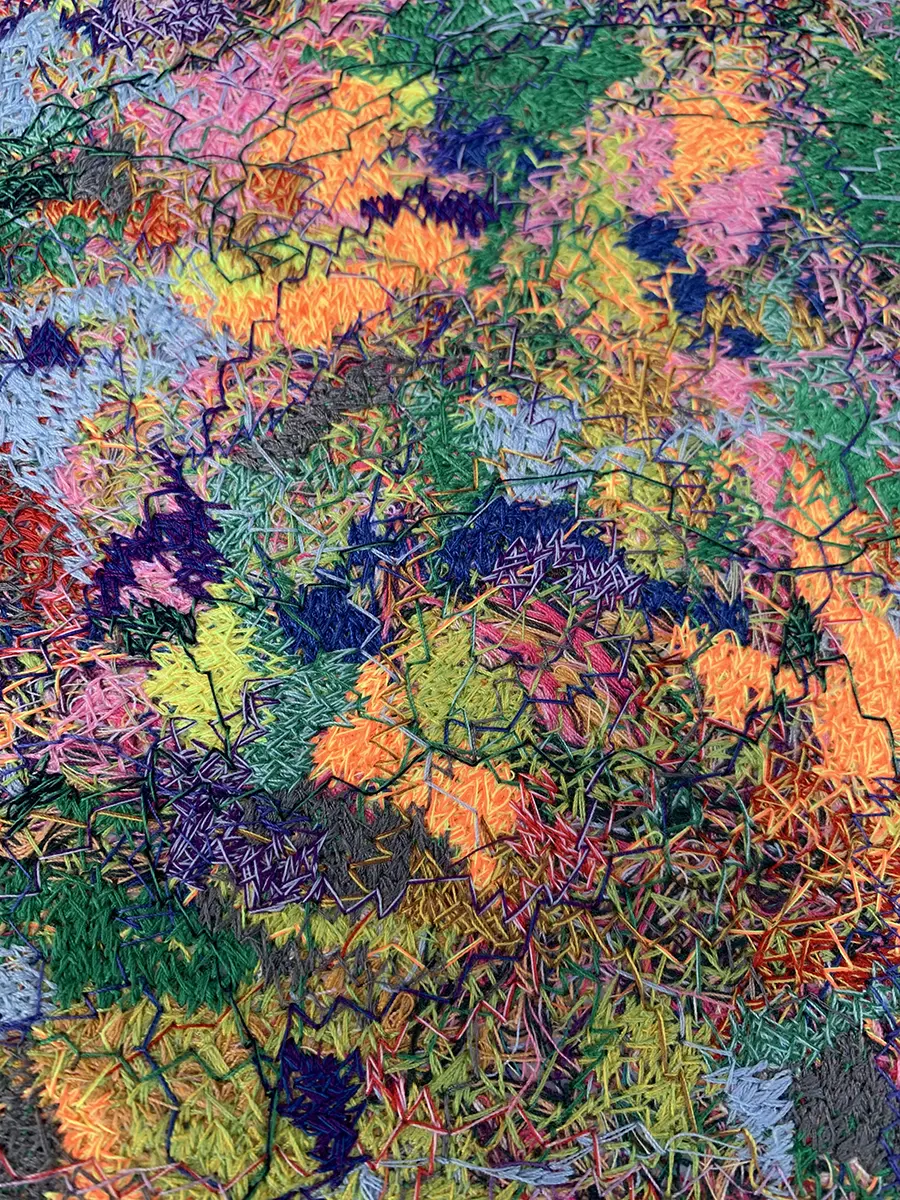
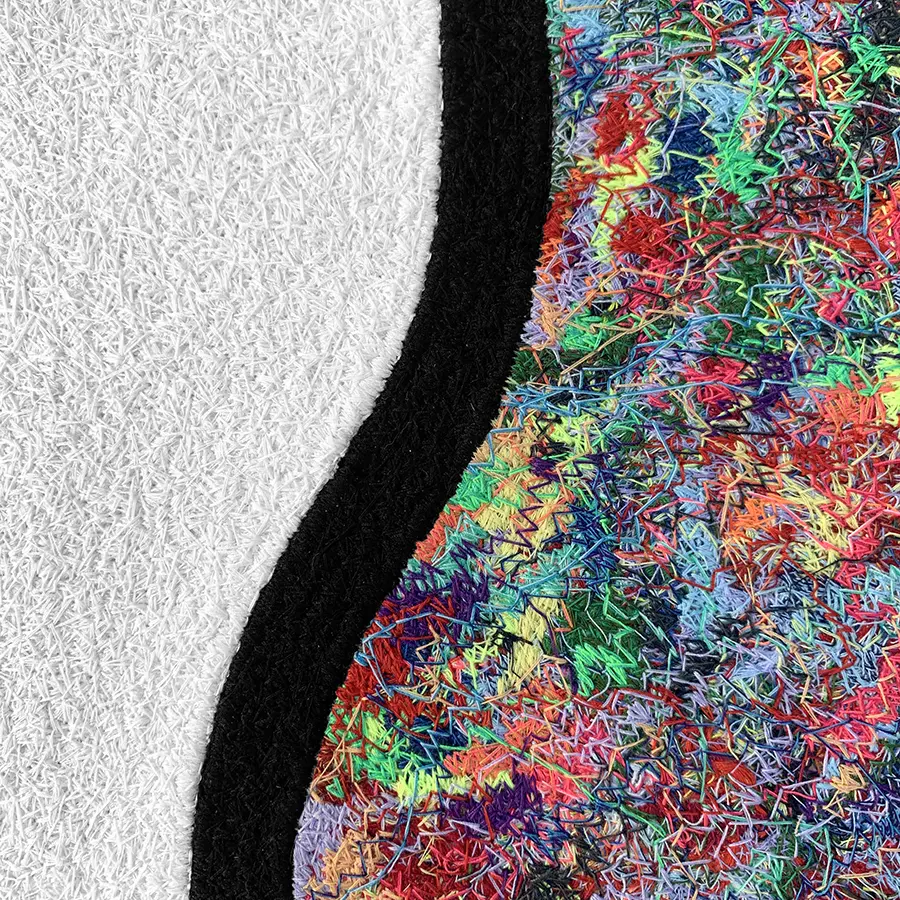
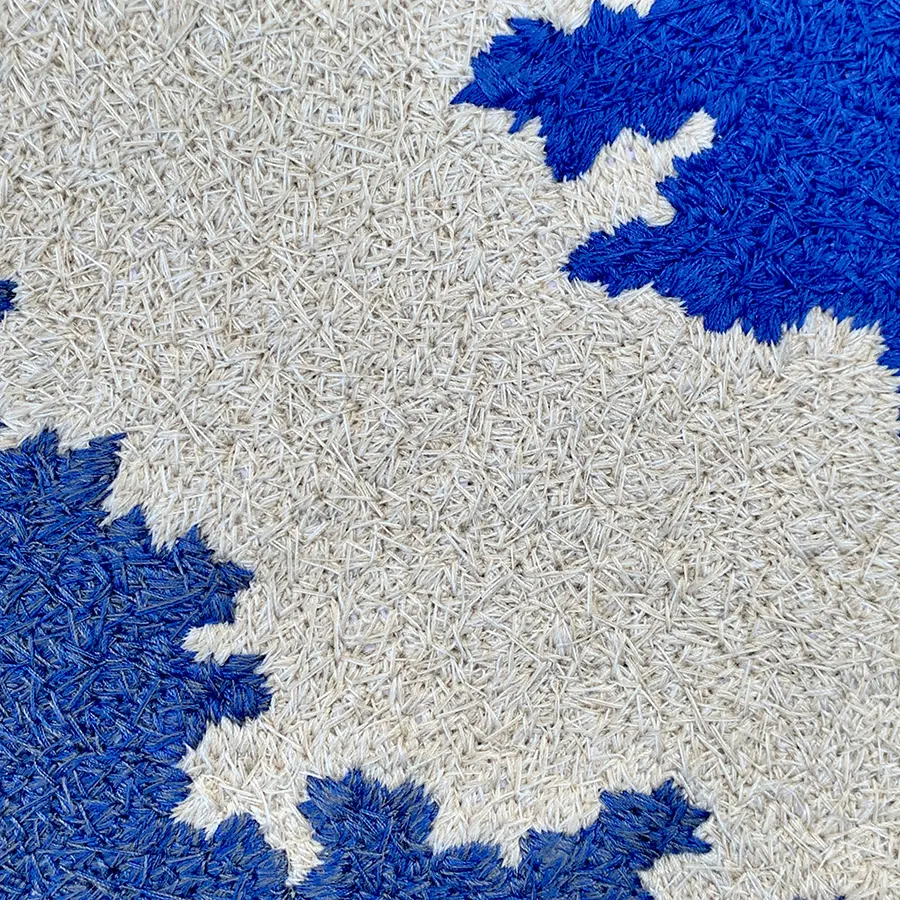
For the individual artworks, I rarely have a plan or design. My method is to cut a piece of fabric, select a thread and start to sew. I keep sewing over and over covering the fabric. As I sew, I draw shapes and patterns and gradually a design emerges. When it feels right, I stop sewing, switch to another coloured thread and continue to sew until the fabric is completely covered in stitch. When I start an individual stitching, I never know how it will end, it emerges from the process.
The design for a collection artwork usually comes out of an individual stitching that has inspired a bigger artwork, but to ensure the design flows between the 9, 12, or 15 artworks, there needs to be a plan. Especially because the gaps between the artworks acts as a bit of an optical illusion, your mind ‘fills’ in the gaps – the design has to ‘look’ right.
This is a process of trial and error but is something that is worked out at the start of the process of creating a collection piece. I start by laying a huge piece of paper out on the floor and drawing out, to scale, the artwork (including the stitchings, the back boards and the spaces between them), I then work over and over to perfect the design.
It is a slow process but it pays off in the end as the lines flow flawlessly from one stitching into the next. Because of this when you look at the collection artworks, you don’t see that they are made from a group of stitchings, instead you are captivated by the design, the colours, the threads and the sense of calmness that the artwork emits.
April 23
April 23 – detail
For more information, commissions and to purchase his artwork please visit JPR Stitch’s website: jprstitch.com
Follow JPR Stitch on Instagram for latest updates.
New interviews and introductions are published weekly, each offering insight and advice into the design & art industries, talking from their unique experiences. We chat with emerging and established interior designers, brand founders and artists.
Immerse yourself into the inspiring brand stories from next generation brands and creatives, along with recommended events and reviews to spark new creative ideas.
Sign up to our newsletters and we’ll keep you in the loopwith everything good and important going on in the worlds of design, art and independent retail.
EXCLUSIVE STORIES AND INSIGHTS
BE THE FIRST TO KNOW ABOUT OUR FEATURE OPPORTUNITIES & EVENTS
STUDIO/ESTILA OFFERS AND MUCH MORE
By subscribing you agree to receive updates from ESTILA. We will not share your data with any third parties. Read our full privacy policy here.
We use cookies on our website to give you the most relevant experience by remembering your preferences and repeat visits. By clicking “Accept All”, you consent to the use of ALL the cookies. However, you may visit "Cookie Settings" to provide a controlled consent.
This website uses cookies to improve your experience while you navigate through the website. Out of these, the cookies that are categorized as necessary are stored on your browser as they are essential for the working of basic functionalities of the website. We also use third-party cookies that help us analyze and understand how you use this website. These cookies will be stored in your browser only with your consent. You also have the option to opt-out of these cookies. But opting out of some of these cookies may affect your browsing experience.
Necessary cookies are absolutely essential for the website to function properly. These cookies ensure basic functionalities and security features of the website, anonymously.
Functional cookies help to perform certain functionalities like sharing the content of the website on social media platforms, collect feedbacks, and other third-party features.
Performance cookies are used to understand and analyze the key performance indexes of the website which helps in delivering a better user experience for the visitors.
Analytical cookies are used to understand how visitors interact with the website. These cookies help provide information on metrics the number of visitors, bounce rate, traffic source, etc.
Advertisement cookies are used to provide visitors with relevant ads and marketing campaigns. These cookies track visitors across websites and collect information to provide customized ads.